Behind The Scenes @ Takedown Festival
- 12 minutes ago
- 6 min read
We spoke to the people working backstage on their relationship with music and how it impacts their mental health at the recent Takedown Festival.

What do you love about festivals? Is it hearing your favourite bands live? The thrill of discovering fresh new music that you cannot stop playing on repeat? Or is it the post-festival high, reading the reviews and thinking, ‘I was there!’
Whatever it is, festivals do not just happen on their own. You can thank the people working behind the scenes for it!
At this year’s Takedown Festival, Tonic Music had the pleasure to speak to many of the individuals that made it all possible, those at the forefront of gigs that music fans adore.
From journalists and radio hosts, to photographers and the Takedown crew themselves, we spoke to the people working backstage about their relationship with music, and how it impacts their mental health.
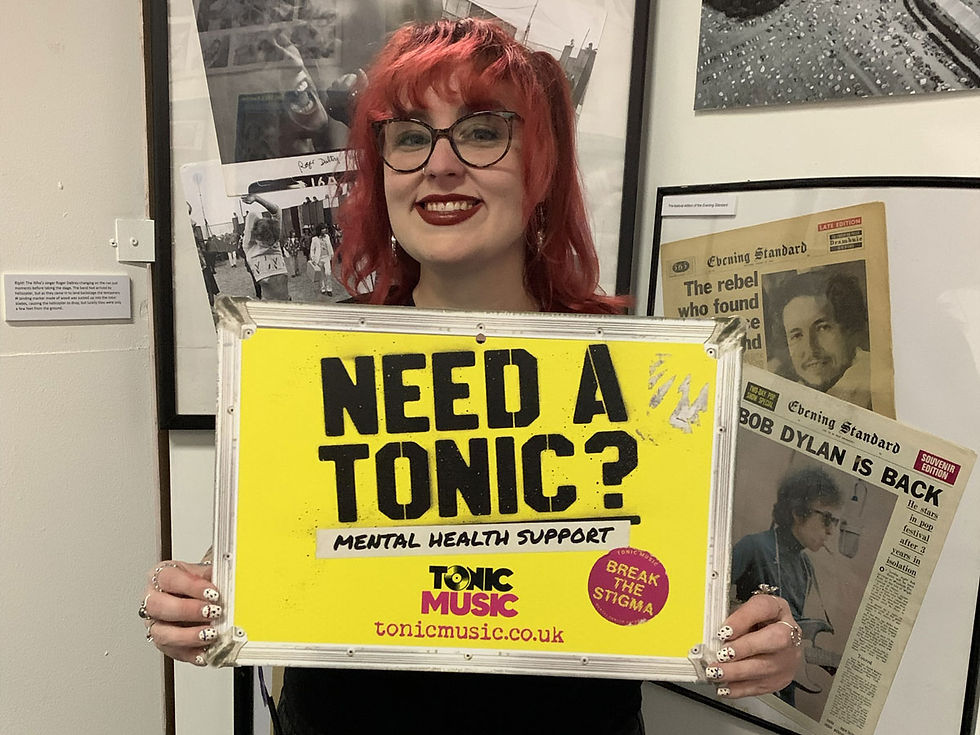
“I used to work within the NHS during the Covid-19 pandemic,” said El (pictured above), who co-runs TotalRock’s sister company We Are TRXSH, “so when it comes to pressure, I have been at the very peak of burnout.”
“So, when it comes to music and what I do now, it feels a lot more relaxed to me. But equally, there is a certain level of pressure because this isn’t something that I have to do, it is something that I want to do, and what I make of this is what I put into it.”
As well as this, El explained the immense pressure on musicians, and how it impacts them negatively.
“I see musicians experience burnout,” she said, “the impact it can have is so hard to deal with.”
[pull quote] “Music can save your life, but if you are someone that struggles with their mental health, be aware of all the support that is around you, like Tonic Music.”

For Takedown’s artist liaison manager, Sophie Holland (above), music is her “emotional outlet.”
“Music is my escape from the humdrum of every day,” she said, “and to be working in an industry that demands so much of you, especially when trying to make a career of it, you have to be in twelve places at once. It is important to take time for yourself and to decompress.”
“It is difficult when you are attending shows as your emotional outlet, and then being someone who works in the music industry. You have to find the right balance between the two, and make sure you have a good friendship group around you. I am very lucky to have found my people through my local alternative scene and the work I do in music.”

It is at music festivals where writer for RockShot Magazine, Nick Allan (above), feels the most pressure.
“Promising that you will go to a concert,” the writer explained, “whether you are there as a writer or as the performer, adds a huge amount of pressure on your shoulders. I have a lot of trouble with that.”
”I always have music on when I am at home, it is a place to escape to. With the variety of music there is, there is something for everything that you feel.”

After admitting she got her steps in after “running around and seeing so many bands,” music photographer Becca Cairns (above) told us she loves “the chaos” of festivals.
“I have started going through an ADHD diagnosis,” she explained, “I really struggle with normal work.”
“This is completely different for me, when I am photographing bands, it’s like I do not have the mental health problem during that half an hour set! I feed off of the energy from live music.”
Despite this, the photographer highlighted the difficulties of getting into music photography, one of the main issues being the rise of social media.
“As a photographer, there are a lot of photographers,” she said, “being a photographer is very social media-based, it is not like what it once was ten years ago.”
“Even being able to afford the equipment on top of putting yourself out there on social media. For someone who has a low income, getting into gig photography is much harder than someone of an upper class, just because of the cost that goes into it.”
Even with this limitation, the photographer explained how “you can take photos on anything.”
“I have seen people use small digital cameras and have come out with incredible work, so I think it is finding what works for you and not let money be a limitation.”

“Music has always been something that I have used and relied on,” said Entertainment Editor for the Portsmouth News, Chris Broom, “it is something I turn to to get through difficult times.”
Being part of the journalism world for over twenty years, the editor feels “lucky” to be able to interview and write about some of his go-to bands and musicians. But on occasion, he struggles to “swallow the inner fanboy” when speaking to his favourites, admitting it has not always been successful trying to do so.
“In the decade that I have been working closely in the music world, things have changed a lot,” he explained, “as a journalist, what we do in the local newspaper, the entertainment role is not valued the way it used to be.”
Despite Chris feeling as if music journalists are a “dying breed,” he urged people who work in the music industry to “carve out time for yourself.”
“Yes, I mix work and pleasure by coming to festivals like this, but you need to be able to separate what is work and what is home life. Make sure work does not become all consuming.”

Writing about her favourite bands was something that music journalist, Emma Wilkes, had always wanted to do since she was a teenager, so when it comes to her work, she tends to “maintain the fan-side” in what she writes.
“My passion has got me to where I am and keeps me going, so holding onto that is really important.”
The music journalist stated how she has always turned to music, before realising that she was neurodivergent.
“I always knew music is a tool that helped to regulate my emotions, even before I realised my brain was different,” she said, “it even helps me to identify my emotions if I do not know how I am feeling, there is always a song that can express how I feel.”
[pull quote] “Being involved in music communities is massively helpful for my mental health in terms of connecting with people and bonding over songs, it helped me realise you are not as alone in your feelings as you thought you were.”

Listening to music is a great way to lift your spirits up when feeling down. Alternatively, “even if you are feeling on top of the world, music can enhance that,” suggested radio presenter, Lily Rose (above).
“Seeing live music gives you an opportunity to forget everything, be in the moment, and enjoy what you are seeing and hearing.”
One of the difficulties the radio presenter has to face is the amount of amazing new music coming out, and “keeping my radio show down to two hours.”
“Having so much great new music coming out is a great problem to have,” she said, “but this is a passion for me, so I need a lot of time to listen to everything that I get sent. My headphones certainly get a workout!”

During the week, both Liz and Beth from Hardbeat Magazine (above) work office-based jobs, but during their spare time, they are attending gigs and festivals whipping up social media posts and articles.
Being able to juggle both the office job and the music industry, however, is the most challenging part for them.
“I have been working at my other job all week,” Liz explained, “and I have come to Takedown to do interviews, with the expectation of getting all of our interviews edited, reviews up and out within three days, and then it is back to the day job.”
“Be selfish,” Liz boldly stated, “if I do an interview today, and it does not go out until later on during the week, some people might expect to see it, but that is better for it to be delayed than for me to be burnt out.”
“Look out for the warning signs for being burnt out,” Beth chimed in, “if you find you do not want to do something or you are feeling overly teary and you do not know why, maybe you need to re-access and take a break. Try and take a step back when you can.”
Don't forget to check out all our Courses, Groups and Workshops currently open for registration for working musicians and those working within the music.